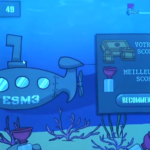

Project Overview
This game was developed as part of a research project led by Christopher Noël.
The goal of the study is to better understand violence in video games by exploring different aesthetic approaches and, in some cases, observing how players react to these stylistic choices.
My role on the project was entirely technical. I worked as a Technical Game Designer, focusing on gameplay systems, tools, optimization, and documentation.
Core Systems I Developed
Save System
I designed and implemented a complete save system supporting player state, progression data, and persistent world variables.
Key elements:
- Clean data structures for long term reliability
- Easy to expand with future gameplay features
- Optimized to avoid unnecessary data writes
This system demonstrated my ability to structure data in a stable, scalable way.
Player Progression System
I created the progression logic that tracks unlocks, player states, and mission advancement.
Focus areas:
- Triggering events via interfaces
- State-driven progression logic
- Conditions for unlocking mechanics or game phases
- Support for quick iteration during research tests
- Blueprint architecture designed for clarity and flexibility
Progression System Documentation
Here is an example using checkpoints actors:


Here is an example using the Objectives actors:


Enemy AI Systems
I worked on several components of the enemy AI, improving both their logic and their reliability.
Navigation and Reaction Logic
I contributed to:
- Target detection and transitions
- State changes based on player behavior
- Consistent and testable AI patterns
Patrol Sector System
I built a system that assigns enemies to predefined zones, allowing them to patrol intelligently while staying within research constraints.
This work shows my ability to design behaviour logic that is clear, predictable, and grounded in good AI practices.


Hands-On Gameplay Mechanics
Grab Mechanic
I implemented the logic that allows the player to grab certain enemies.
This feature required coordination between animation, collision, and state management.
What this demonstrates:
- Interaction scripting
- Player-enemy state transitions
- Handling complex Blueprint condition chains
Glory Kill Mechanic (AKA BloodBath system)
I designed and scripted the core logic for a special finishing mechanic triggered under specific conditions.
Technical focus:
- Trigger events
- Animation cues and timing
- Condition handling
- Clean transitions between enemy states
The system was built to be tunable for research purposes without needing code adjustments.
BloodBath system Documentation
With the BP_GlorykillComponent, an enemy exceeding the threshold will be stunned indefinitely and can be grabbed.

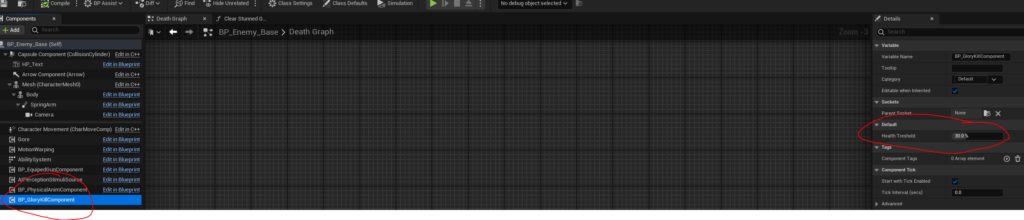
I even created the associated visual effects:
Documentation Workflow
Throughout the project, I produced structured and accessible documentation, including:
- Feature breakdowns
- Setup guides
- Diagrams explaining system logic
- Updating documentation after iteration phases
My goal was to make every system understandable and reusable by teammates and researchers.
Here are some examples of documentation I have created:
Optimization Work
I optimized several aspects of the gameplay and AI systems:
- Reduced unnecessary Tick usage
- Improved Blueprint logic flow
- Reduced trace and collision load
- Ensured AI systems behaved consistently during stress tests
- Upgraded the Unreal Engine project from 5.4 to 5.7 and to later versions in the future as needed.
This helped stabilize performance during high intensity sequences, which was critical for the research environment.
Results and Impact
My contributions helped establish the core gameplay foundation of the research project.
The systems I developed allowed the team to test player responses reliably, while giving researchers consistent data points across play sessions.
This project strengthened my skills in:
- Technical game design
- System architecture
- AI implementation
- Problem solving
- Collaborative documentation
Conclusion
Working on this research project allowed me to grow as a Technical Game Designer, especially in systems design, Blueprint programming, and AI behaviour implementation.
I am proud of the gameplay tools and mechanics I delivered, and I look forward to applying these skills to future professional projects.
If you want to know more or discuss my work, feel free to contact me or explore the rest of my portfolio.